

A Meeting With Amrita Pritam
A Meeting With Amrita Pritam
During my diplomatic life, I often had a chance to see and meet with different personalities of the political world as well as arts & cultural and religious figures. When I heard about the passing of Amrita Pritam in the news in October 2005, I was shocked and had a sort of flashback about all her conversations during a meeting in Hauz Khas, about 27 years back.
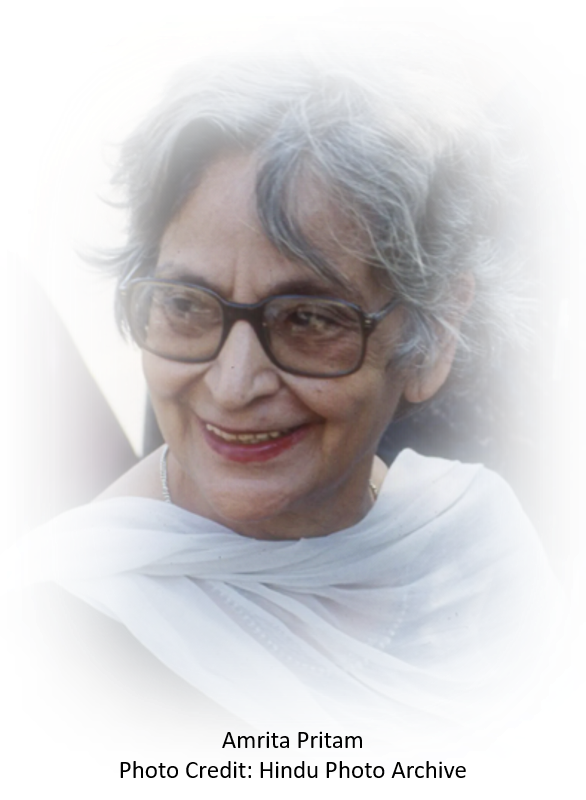
I remember my meeting with Amrita Pritam in 1978 in New Delhi. She was an Indian writer and poet, considered the first prominent female Punjabi poet, novelist, and essayist, and she was also considered the leading 20th-century poet of the Punjabi language. Amrita is equally loved on both sides of the border of the Indian subcontinent. She is most remembered for her poignant poem, “Aj Aakhaan Waris Shah Nu” (Today I invoke Waris Shah - "Ode to Waris Shah"), an elegy to the 18th-century Punjabi poet, and an expression of her anguish over massacres during the partition of India. But I was inspired after reading her autobiography “The Revenue Stamp,” the English version of “Raseedi Ticket.” This book became very popular just after its publication, I believe in 1976. Since I am very fond of reading books on different topics, I had a chance to buy the book in New Delhi, and read it twice. I found the writer of this book deeply involved in love with Pakistan, its heritage, and friends from Pakistan. The reason might be that Pakistan is her birthplace and she was born and raised in Gujranwala and Lahore.
I was posted at the Pakistan Embassy in New Delhi from January 1978. I knew a couple of local embassy staff who were familiar with the area, and also with Amrita Pritam. I planned to meet her with the help of one of my local staff, Aziz Khan. After a week of communication, she gave us a time to meet her at her Safdar Jang Enclave, Hauz Khas residence in New Delhi. It was mid-August 1979, about 7:00 p.m. I rang the doorbell and a young man, perhaps her aide, opened the gate and took us into the drawing room. The house was built in stone with tall windows, trailing with bougainvillea and different flowers like haarsinghar tree. The lawn was well maintained and strewn with tiny flowers.
After a while, Amrita Pritam entered the drawing room and greeted us with enthusiasm. She was a gorgeous 60-year-old lady, but one could feel that she was still energetic. After greeting us with folded hands, she took her seat on the front sofa. Her Urdu or Hindi was mixed with a Punjabi accent.
In her sixties, she still had many memories of her native land, Gujranwala and Lahore, where she grew up until she migrated to India in 1947. Her mind was still in the past, and she remembered each one of her friends from Pakistan, like Sajjad Haider, Faiz Ahmed Faiz, and many others. Amrita Pritam still remembered each little alleyway and street where she spent her blossoming life and was married to Pritam Singh, a prominent businessman’s son. But it was not a long-married life.
Though she was from a religious Sikh family and her father was a religious preacher, Amrita was a very modern type of woman until her death. Even though she went against her Sikh tradition and cut her hair when she fell in love with Imroz, she did not change her religion. Imroz was also from a Sikh family, but unlike traditional and religious custom, he did not have a beard. Unfortunately, he was not at home that evening due to a prior commitment elsewhere. Imroz was her lifetime companion till her death in 2005.
She was a very broad-minded lady and did not hesitate to disclose her love affairs with laureate personalities such as Sahir Ludhyanvi, and Imroz. She also mentioned about her deep feelings toward Sahir in her biography. She remembered Sajjad Haider, her very best real friend from Pakistan.
In her autobiography “The Revenue Stamp,” she writes
“Sajjad was in Delhi for a good eighteen days. Nights he spent at Marina Hotel, days at my house. This was the first time in my life I realized I had a friend in the world, a friend in every sense of the word. For the first time ever, it dawned on me that a poem does not need to be created out of the passion of love. It can waft across the calm seas of friendship. At parting, I wrote:
and live with me
Buy me a pair of wings, Stranger
Or come and live with me”
In a remarkable sentimental statement, she mentioned a cultural get-together in London, where she met with Fehmida Riaz, Shahab Qizilbash, Saqi Farooqi, Abdullah Hussain and prominent classical singers Nazakat Ali and Salamat Ali. She also mentioned Faiz Ahmed Faiz and Ahmed Nadeem Qasmi during the conversation.
One could see in her eyes the emotions and love of friends and land, which she left due to geographical conditions and politics.
She was very hospitable and courteous by nature, and she proved it by talking with me for more than an hour, serving us delicious desserts, samosas, and coffee. I looked at my watch - it was around 8:30 p.m. I realised it was time to thank her for being so courteous and friendly. She had spent more time than she had originally given us for the appointment. She walked us to the gate to say goodbye and shook hands.
It was one of the best times I ever spent with any laureate person of the Indo-Pak subcontinent, who was very rich in bagging so many prestigious Indian literary awards to her credit.