

A Dream That Refused to Die
A personal memoir on the birth and journey of Autism Welfare Foundation.
Every establishment has a history. Some begin with a vision, others with an opportunity. Autism Welfare Foundation began with neither. It began with one young girl, one strong-minded mother, and a dream that refused to die.
Just 5.5 km from the bustling streets of modern-day Dhanmondi, one comes across an abrupt shift in the surrounding atmosphere. Quite suddenly, the horns of vehicles die down, the buildings clear to reveal the bright blue, sunlit sky, and the roads wind into what can only be described as a slow-paced suburban life that city residents can only dream of. This is Bosila, and if one travels a further seven minutes from Bosila Bridge, they will come across a massive four-storied, 10,000 sqft building standing tall on more than one-third of an acre of land, where children, adolescents and adults on the autism spectrum spend each day meaningfully and to the fullest. This is the campus of Autism Welfare Foundation (AWF), which has completed 22 years of its journey this year.
When any new visitor enters the AWF campus, they are met with sheer wonder and admiration. It is doubtful whether any other open-plan campus on such a large scale exists for autistic students in Dhaka, let alone in Bangladesh. The U-shaped building encloses an open-to-sky courtyard, and each floor surrounding this courtyard caters to different functions of AWF's daily operations. Specialized classrooms, therapy rooms, an indoor therapeutic swimming pool, a 20-foot-high indoor multipurpose hall, a computer lab, a vocational training centre, and a professional seminar room— the building hosts everything needed to improve the lives of students, both young and old. Indeed, it seems like a dream school for autistic students of all ages, ready to help them take on every single day with confidence and purpose.
But AWF only shifted to these premises in early 2018. Before that, it began its journey in 2004 in a rented, outdated, four-storied 1,500 sqft building in Shyamoli, under the leadership of Dr. Rownak Hafiz, my mother, the Founder Chairperson and Chief Advisor of AWF. AWF can never be spoken about without mentioning Dr. Hafiz by name. Without Dr. Hafiz, there would have been no AWF. In fact, there would not have been the special schools, therapy centres, clinics and many of the other services for autistic individuals that are available today, as she was the pioneer of autism in Bangladesh.
Her journey in the field of autism did not begin in 2004; it began much earlier, in 1988, when her elder daughter, Miti, was born. Her unseen battles, struggles and tears began almost four decades ago.
When Miti was one and a half years old, Dr. Hafiz noticed that although she was speaking many words and even full sentences, she was not as communicative or social as her elder brother had been at that age. Upon discussing this matter with her fellow medical colleagues, Dr. Hafiz admitted Miti to YMCA School, a very popular English-medium school in the early 1990s, when she turned three.
Miti’s father, Arch. Masum Kabir (Founder Director of AWF), always accompanied Miti throughout her classes, despite repeated assurances from the class teachers that she would do just fine in that environment. They all thought that, with new friends and a playful classroom setting, she would eventually overcome her social development challenges.
But little did anyone expect that a much more serious and life-altering condition was at play. When Miti turned four, Dr. Hafiz realized that something was just not quite right and that an underlying issue was present. She again sought help from numerous doctors and later admitted Miti to another school. There, the class teachers remarked that while Miti was quite skilled at reciting various rhymes and participated willingly during tiffin break, she could not concentrate on her academic studies at all and was unwilling to attend those classes.
Dr. Hafiz continued to persevere. She also made a trip to Thailand, but even there no proper diagnosis of Miti’s condition was produced. She prayed that one day Miti would study successfully at one of the top mainstream schools in Dhaka and would have a large circle of friends and peers with whom she could form lifelong, meaningful bonds. Alas, that long-awaited moment never came.
At the end of 1995, Dr. Hafiz temporarily moved to the USA for Miti’s diagnosis. Arch. Kabir was unable to make the journey. There, after multiple appointments, the diagnosis at the University of Iowa Medical Hospital and Clinic concluded that Miti had Autism Spectrum Disorder (ASD). They advised Dr. Hafiz to stay back in the United States and admit Miti to one of the inclusive schools located in Iowa.
From that very moment began Dr. Hafiz’s journey into the unknown world of autism. Miti was admitted to Hoover Elementary School’s Mainstreaming Program, where she followed most of the educational curriculum alongside other neurotypical students. At that time, many schools across the United States offered Mainstreaming Programs, where students with special needs received services tailored to their individual goals and needs.
Before Miti’s admission, Dr. Hafiz first visited the school campus. She was mesmerized by its vast structure, open grounds and modern facilities, unlike anything she had seen at that time. Miti’s schooling involved close teamwork between Dr. Hafiz, the teachers and her consultants. She adapted extremely well to this new school setting, where both neurotypical and neurodiverse students learned side by side and participated in all activities together. It felt like a magical alternate universe— a stark contrast to the unsatisfactory and uncooperative schools she left behind back in Dhaka. Two years went by in the blink of an eye.
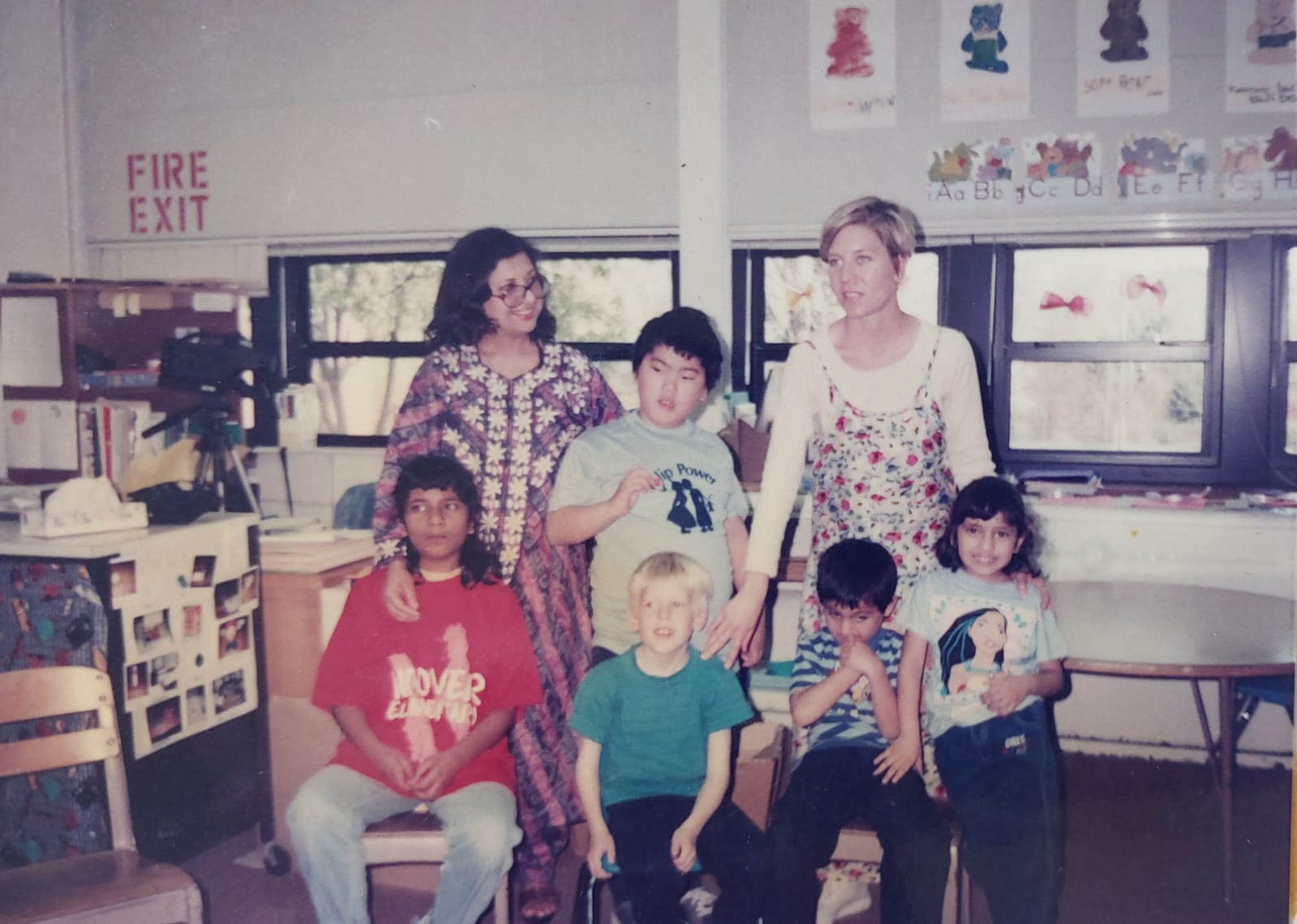
Miti (left, in red) on her last day at Hoover Elementary School, Iowa, before returning to Dhaka in 1997. Standing behind her is Dr. Rownak Hafiz.
In the summer of 1997, Dr. Hafiz, along with Miti and her other two children, had to return to Dhaka. Before leaving, the educational consultants at Hoover suggested that Miti should be enrolled in a similar educational program in Bangladesh so that she could continue interacting with neurotypical children. Dr. Hafiz then contacted the Principal of Miti’s former school, and after explaining her vision for such a program, the Principal enthusiastically agreed.
Thus, a program was established in 1998 at Step by Step School, a former English-medium mainstream institution located in Lalmatia. Other neurodiverse children like Miti were also enrolled in that class. Dr. Hafiz planned the program thoroughly to enable Miti and the other students to participate successfully in all classes alongside their neurotypical peers. She was finally relieved— Miti would once again be attending a mainstream school, with caring and dedicated teachers who had been directly trained by Dr. Hafiz.
Nothing lasts forever, not even bliss. Soon after the launch of this special education program at Step by Step, parents of neurotypical students started swarming in, and began lodging complaints against its operation. They were resolute in shutting down the program, stating that they did not want their "normal" children to even remain in the same building as these special students, fearing that their developmental disorders might somehow be "contracted." They were also far less compassionate and understanding, unwilling to accommodate the various behavioural and social challenges these children faced.
Sadly, the program came to a halt in mid-1999. But that did not stop Dr. Hafiz. She was determined to establish the very first special education program for autistic children in Bangladesh. Along with five other parents of autistic children, she started a special program named TEACH in a rented three-bedroom house in Mohammadpur. Very soon, word spread, and more parents wanted their children to be enrolled in such a specialized program.
By this time, she had already left her part-time position as a child physician at Popular Clinic and was dedicating herself full-time to researching and developing the field of autism in Bangladesh. In 2000, with the cooperation of other parents, Dr. Hafiz founded an institute named the Society for the Welfare of Autistic Children (SWAC), a special education and training program for autistic children where the entire curriculum was devised by Dr. Hafiz herself. Miti and the other students at TEACH shifted to SWAC. Activities were conducted on the first floor of a rented old building in Iqbal Road.
Through numerous newspaper articles and the limited media platforms available at the time, the activities of SWAC gradually became known to the general public. Many people who had never even heard the word autism were now learning about it and were amazed that the country's very first institute dedicated to autism had been established in Dhaka. The number of students quickly grew from six to twenty, and the organization eventually had to rent the ground floor as well to accommodate the increasing enrolment. By 2003, SWAC was running its education and training operations for students in two shifts – one morning shift, and another day shift.
By this time, Miti and her peers had entered their teenage years, and, keeping their changing needs in mind, Dr. Hafiz launched the very first vocational training centre for autistic adolescents and adults in Bangladesh within SWAC. The program was a huge success— Miti and her peers were finally going to a school they could truly call their own.
For various internal conflicts and issues, Dr. Hafiz had to resign from SWAC in late 2003. She then went on to finally establish Autism Welfare Foundation (AWF) on 4th April 2004 in Baitul Aman Housing Society. The same programs she had developed at SWAC were replicated at Kanon: School of AWF.
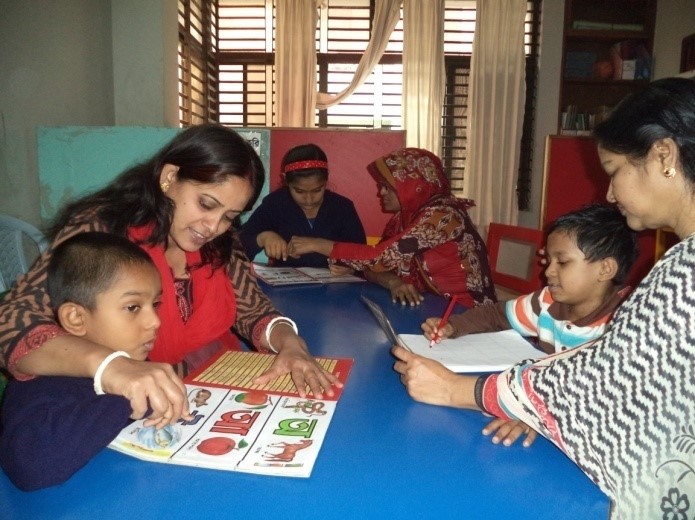
Early years of autism education in Bangladesh through AWF (2005)
After the operations of AWF began, she noticed that some students were more capable and developmentally advanced than others and could concentrate long enough to study under the regular NCTB curriculum, just like their neurotypical peers.
Thus, she developed a specialized NCTB-based curriculum for these Advanced Level Program (ALP) students, where they received both academic education and the specialized training program of AWF. To date, up to 50 students from AWF have successfully passed the National Board Examinations of Bangladesh, and around 81 students have transitioned to mainstream schools or colleges. For Dr. Hafiz, every student who sat for a national examination was another reminder that autism should never define a child's potential. Some ALP alumni, such as Poshla and Abir, have even become successful entrepreneurs, running their online arts and crafts businesses professionally.
By 2006, most medical practitioners and educators were becoming increasingly aware of autism and were also getting involved in developing programs and practices to improve the lives of autistic individuals in Bangladesh. The role of therapists— especially Occupational Therapists and Speech Therapists— became increasingly significant in the diagnosis and specialized intervention programs for individuals with ASD. Dr. Hafiz also introduced Occupational Therapy and Speech Therapy programs at AWF around the same time that this approach began gaining traction.
The entire program at AWF followed a Multidisciplinary Team (MDT) approach utilizing Collaborative Consultation, where parents, educators and therapists worked together to develop joint intervention plans for students and establish shared goals.
Despite AWF’s continued success and immense popularity among parents, medical professionals and social workers, one problem always threatened its existence: it was still operating from rented premises, where monthly and yearly rents had to be paid on time. With rising inflation, and given that AWF followed a non-profit, volunteer-driven welfare model, it was often painfully difficult to bear these costs.
The organization later shifted its activities to another rented building in Shekhertek, but even there, the increasing rent eventually caught up with them. There were other buildings in the same vicinity with lower rental costs, but many owners were unwilling to allow neurodiverse individuals to enter their buildings, let alone occupy them five days a week.
During those difficult times, Dr. Hafiz would often look back on the days in Iowa, where Miti had spent some of the happiest years of her life on the beautiful, expansive campus of Hoover. If only the children, adolescents and adults at AWF could one day study in a permanent campus of their own, free from the constant fear of eviction. That dream stayed with her every single day.
Many parents and teachers who have been a part of AWF since its inception often remark, especially during such trying times, that the Almighty always stands by those who work for the betterment of humanity and never leaves them stranded. Dr. Hafiz witnessed this once again when Hafizur Rahman Khan, Chairman of Runner Group of Companies, donated a large plot of land in Bosila, Keraniganj, for the construction of AWF’s permanent campus during 2014–2015. After years of uncertainty, the dream that had once seemed impossible was finally beginning to take shape.
Arch. Masum Kabir, being a renowned and accomplished architect himself, began planning and designing the campus as an eight-storied structure in its optimum form, equipped with all the facilities required for autistic individuals— including a therapeutic swimming pool, a multipurpose hall and an assisted living facility on the upper four floors for when the students grow older.
Runner Group, along with other notable organizations such as BSRM Group, AB Bank, MGH Group, Confidence Group, and many generous benefactors and well-wishers, contributed towards the construction costs. By March 2018, the first four storeys of the building were successfully completed, and AWF finally shifted to its permanent home.
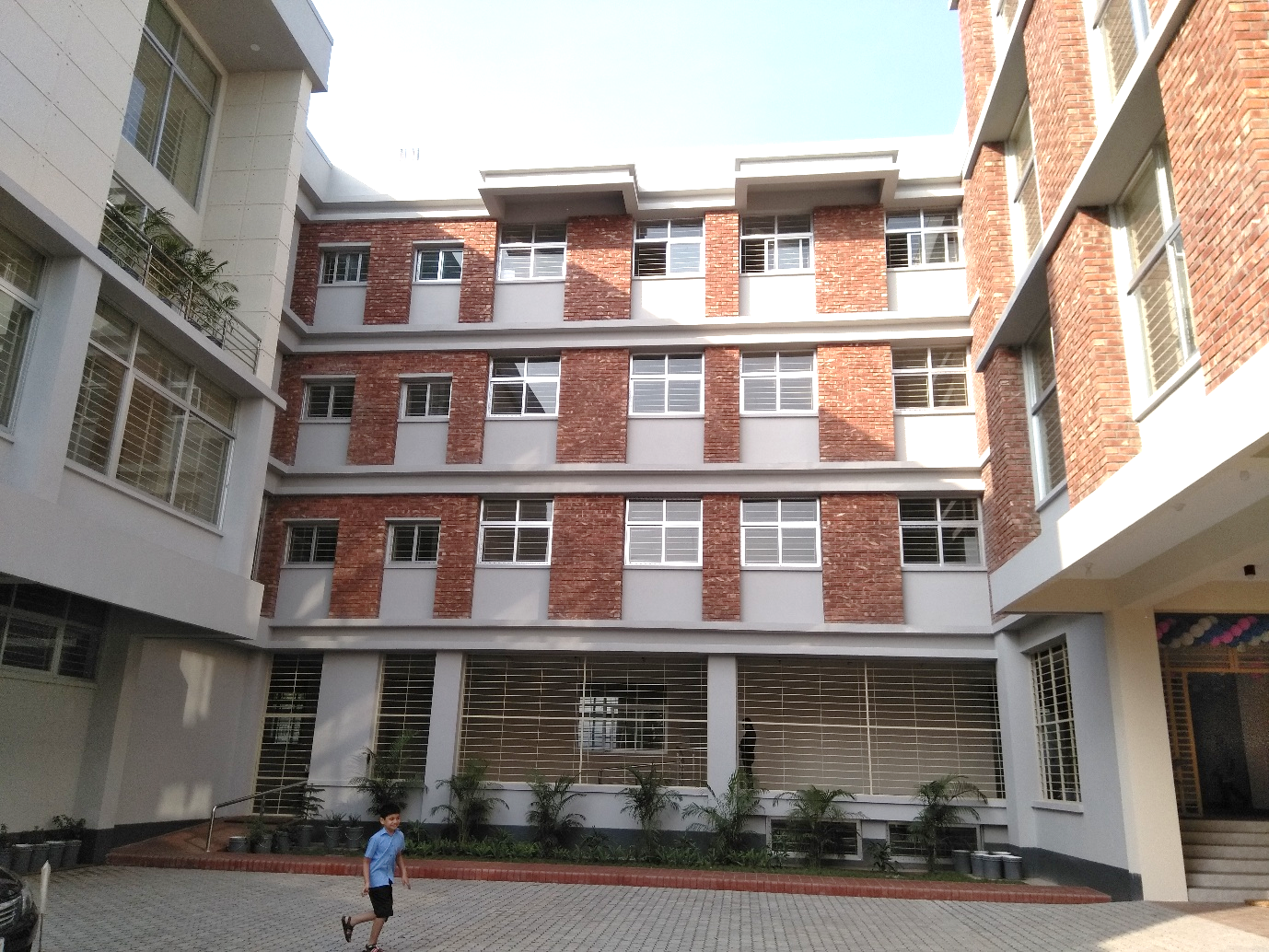
Autism Welfare Foundation’s permanent campus in Bosila— a dream fulfilled after years of endurance and collective generosity.
All was well in the world of AWF. Students, teachers and parents were ecstatic to be able to teach and learn in this sprawling campus, and it felt as though everything would be okay. However, in 2020, the campus had to shut down for two years due to the COVID-19 lockdown.
Even then, no one lost hope, and AWF continued its educational and training services through online classes— a very difficult challenge indeed, given that many of these students possessed limited attention spans. Still, teachers, parents and therapists worked together to ensure that the students continued receiving specialized educational and training programs while being quarantined at home. Amidst one of the darkest chapters in recent history, something extraordinary unfolded. Parents became teachers, teachers became counsellors, and therapists entered homes through computer screens, proving that compassion and perseverance could overcome even the greatest distances.
On 8th April 2021, the curtain once again fell on AWF when Arch. Masum Kabir passed away unexpectedly due to COVID-19. Arch. Kabir, along with Dr. Hafiz, was one of the two steadfast pillars of AWF, and every fruit that blossomed within the organization was the result of the seeds they had sown and the care, nurturing and unwavering dedication they had always given to it.
It was an extremely shocking and numbing loss for the entire AWF community. To this day, no one has truly accepted this cruel reality. Dr. Hafiz, too, seemed to have frozen in time after this devastating loss.
Nothing lasts forever. Despite these devastating blows, the rest of the members and stakeholders of AWF came forward, and together they continue to work tirelessly to uphold the ideals and beliefs of Arch. Kabir and Dr. Hafiz, while carrying forward the vision they dedicated their lives to building. With their encouragement, dedication and unwavering commitment, AWF successfully completed the construction of its indoor swimming pool in early 2026, and students now enjoy supervised swimming classes every week. Sadly, Arch. Kabir never saw the completed swimming pool.
Today, the campus continues to grow, with new facilities and programs being introduced to meet the changing needs of autistic children, adolescents and adults. Every new milestone achieved by AWF stands as a tribute to the dreams of its founders and a reminder that compassion, perseverance and hope can overcome even the greatest challenges.
In between the tides of glimmering hope and abrupt obstacles, AWF continues to fight to address two extremely important challenges. One is the construction and operation of a specialized assisted living facility for these students as they grow older. Most of these students were enrolled at AWF as children, but 22 years down the line, they have become adults, and their parents are now facing the difficult reality of what will happen to their children when they are no longer on this earth. What will happen to Miti when Dr. Hafiz is no more present?
Moreover, no successful residential program of this kind currently exists in Bangladesh. In addition, due to extremely limited funds and resources, it has not yet been possible to begin constructing the upper four floors of the campus, where this assisted living facility is planned.
Another challenge is the dream that Dr. Hafiz was first exposed to during her time at Hoover— where neurodiverse and neurotypical children learned side by side on the same school campus, unfazed and unbothered by their differences. Unfortunately, despite autism becoming a familiar term in many Bangladeshi households today, many people still hold deep-rooted prejudices and are unwilling to accept autistic individuals in their homes, mainstream schools or workplaces. Even though the lifestyles and trends of the Western world are increasingly reflected in the daily lives of our citizens, the same level of acceptance and inclusion of autistic individuals has yet to take root in our society.
Autism Welfare Foundation continues its journey through an ever-changing landscape, one step at a time. In its 22 years of existence, it has witnessed many highs and many lows. Yet, bearing the weight of its founders' legacy, AWF continues to strive for excellence and remains devoted to serving, caring for, and nurturing all of its 150 students. Many more milestones remain to be achieved.
It is our collective responsibility as a society to take a step forward and ensure that this flame of hope continues to burn brighter with each passing day. After all, the true measure of a society is not how it treats its strongest members, but how it embraces those who need its support the most. As long as there are compassionate hearts willing to stand beside these individuals and their families, the journey of AWF will continue— one filled with hope, dignity and the unwavering belief that every person deserves the opportunity to live a meaningful and fulfilling life. Every morning, as the gates of AWF open and students begin walking through its corridors once again, they are not merely entering another school. They are stepping into a dream that began almost four decades ago with one little girl, one determined mother and one family's refusal to give up.